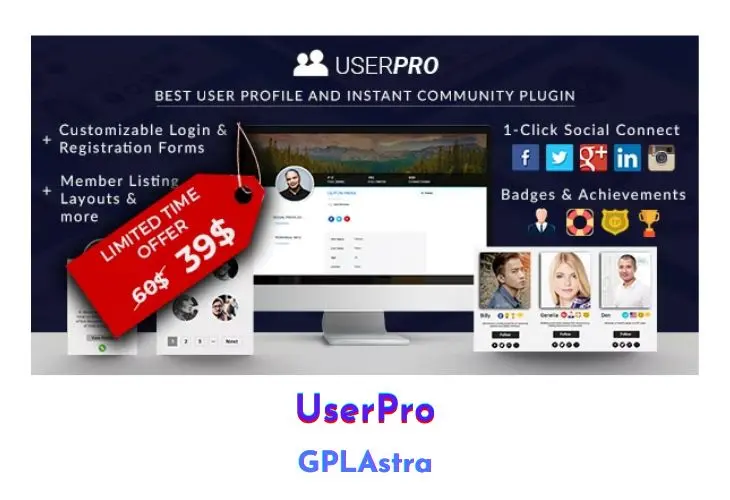
UserPro is an all-in-one plugin that helps you create a complete community website with beautiful front-end profiles, login, and registration functionality for WordPress. It offers a wide range of features, including social connect and integration, viral marketing, user badges, verified accounts, content restriction, public/private activity feeds, and more. UserPro is designed to provide a comprehensive solution for building a vibrant and engaging community around your website.
Core Features of UserPro WordPress Plugin
- Beautiful front-end user profiles
- Seamless login and registration process
- Social connect and integration (ability to connect with social media accounts)
- Viral marketing tools
- User badges and achievements (manual or automatic assignment, custom badge uploads)
- Verified accounts feature
- Content restriction (full page/post restriction based on user roles or verified accounts)
- Site-wide or specific page locking for logged-out users
- Follow/Unfollow feature (users can follow/unfollow other community members)
- Social activity stream (public and private feeds showing recent user activities)
- Member listing layouts (standard table format, collage layout, customized lists)
- Member directory search with standard and custom filter options
- Enhanced members directory
- Front-end publisher (users can publish content directly from the front-end)
- Posts made by user (display posts by author dynamically, including on user profiles)
- Fully responsive design
- Shortcodes for displaying followers, following, and more
- Integration with custom post types and post categories
- User role management and permissions
- Customizable styling and branding options
- Translation-ready and multilingual support
- Regular updates and maintenance
What’s New (Changelog) in UserPro v5.1.18
Version 5.1.18 (18 Nov 2026)
==================================
Security release. Please update.
- Security: Unauthenticated privilege escalation through registration
(critical, CVSS 9.8). Reported through Wordfence by 0xd4rk5id3.
default_role() is the function that assigns a role to a newly
registered account. Its only restriction was a case-sensitive
comparison against the literal string "administrator", so any other
value supplied in the request was passed straight to set_role(),
including capability names such as create_users or manage_options.
The Facebook Connect registration branch handed the raw request array
to new_user() without the allow-list check that the normal
registration form applies, so an unauthenticated visitor could create
an account holding an arbitrary capability and then use the WordPress
REST API to create a full administrator account.
A requested role is now accepted only when it appears in the
configured Allowed Roles list and is a role actually registered with
WordPress, which also rejects capability-shaped strings.
"administrator" is never assignable during registration regardless of
configuration, and unusable values fall back to the configured default
and then to subscriber. The same resolution is applied to the role
taken from the session. As defence in depth the Facebook branch no
longer passes the raw request array into new_user() and strips the
role and capability keys before it does.
Administrator-initiated role changes in the admin screens are
unaffected: they do not pass through this function.
(functions/api.php, functions/ajax.php)
- Security: Unauthenticated account takeover via Facebook Connect
(critical). The userpro_fbconnect endpoint verified the caller's
Facebook access token against the Graph API, but then selected which
account to log in using a separate social id taken from the request.
That id is produced in the browser from public values only (the first
eight characters of the public Facebook app id, DES encrypted over the
Facebook user id, then hex encoded) and contains no server secret, so
it could be submitted for any account and the server would reproduce
the stored value and log the caller in with no password. The id
returned by the verified Graph API response was fetched and never
compared against it.
Every login path in the handler is now bound to the email address that
Facebook confirmed for the presented access token, through the new
userpro_fb_identity_matches() check. This covers the returning social
id path, the existing email path and the username match path, the last
of which previously logged a caller into any account whose username
happened to match the Facebook first and last name with no email check
at all. Where a stored social id matches an account whose email is not
the verified one, the request now stops with a message asking the user
to sign in with their password and reconnect Facebook, rather than
creating a duplicate account. (functions/ajax.php)
- Security: Missing authorisation on the connection endpoints. Accepting
a connection request wrote into the target user's meta without
checking that the target had ever sent a request, so any logged in
user could force a connection to any account. On sites that gate
profile fields behind connections this exposed private profile data.
Accepting now requires a matching pending request, all three endpoints
require a logged in caller, and the user id is cast to a whole number
and confirmed to exist. (functions/ajax.php)
- Security: Activity feed disclosure. The refresh and load activity
endpoints took the feed owner's user id from the request, so anyone,
including visitors who were not logged in, could read another member's
private following feed by passing their id. The private feed is only
ever rendered for the viewer's own account, so the owner is now always
the current user. A posted zero still selects the public all users
feed, so the open to all mode is unchanged. The activity_user filter
is now restricted to the literal "self" or a list of user ids.
(addons/social/functions/ajax.php)
- Security: Login CSRF in Google sign in. The callback accepted any
authorization code delivered to it, because the OAuth state was
generated, sent to Google and then discarded: it was only written to
the session inside a branch the callback never reaches. An attacker
could therefore cause a visitor's browser to complete a Google sign in
the visitor never started, landing them in an account the attacker
controls. The state is now recorded when the authorization URL is
built and verified with hash_equals() on return, once only, and the
sign in is rejected if it does not match.
(functions/socials/GoogleAuth.php)
- Security: Exported user list was readable by anyone who guessed the
file name. The CSV of every exported user, email addresses included,
was written into the uploads folder as a Unix timestamp plus ".csv",
which is trivially guessable, and is served with no access control.
The name is now 32 random hex characters. This also fixes a bug that
could produce a dead download link: the timestamp was recalculated
when the link was built, so an export that crossed a second boundary
linked to a file that did not exist.
(admin/admin.php)
- Hardening: folders the plugin creates inside uploads are no longer
created world-writable (0777). The downloads folder, the plugin's
upload base folder and per-user upload folders now use WordPress's
configured directory permissions, 0755 by default.
(admin/admin.php, functions/api.php)
- Security: SQL injection in the admin user export. The row limit was
interpolated into the query string before $wpdb->prepare() ran, which
prepare() cannot sanitise. It is now a %d placeholder and the value is
cast to a whole number. Reachable only by an administrator holding
manage_options. (admin/admin.php)
- Security: Reflected cross site scripting on the badges admin screen.
The bid query parameter was echoed into an input value unescaped. It
is now cast to a whole number and escaped. Reachable only by an
administrator holding manage_options. (addons/badges/admin/panels/manage.php)
- Fix: PHP 8 fatal error in the bundled Campaign Monitor library.
services_json.php used the curly brace string offset syntax removed in
PHP 8.0 in 38 places, so saving a registration or profile with a
newsletter field ticked crashed on any PHP 8 site with Campaign
Monitor configured. Converted to square bracket offsets.
(lib/campaignmonitor/class/services_json.php)
- Fix: PHP fatal error in the Mailster subscriber check.
mailchimp_is_subscriber() required a file through a
MAILSTER_DIR_USERPRO constant that this plugin never defines, so the
call crashed whenever Mailster integration was on, no MailChimp key
was set and a newsletter field rendered. The require and the unused
subscriber object have been removed; the query below them does the
work. (functions/api.php)
==================================
Similar Plugins
Download UserPro Latest Version
- 1 UserPro DashBoard v3.7 2 months agoProvides Dashboard for every user .
- 2 MemberList Layouts for UserPro v1.0 2 months agoUnique layouts of the UserPro Memberlist
- 3 Private Messages Add-on for UserPro v4.9.2 2 months agoAllow users to send a message to each other, view/manage messages, and block users.
- 4 Social Wall Add-on for UserPro v4.4 2 months agoAllow users to post, comment and interact with each other.
- 5 Tags add-on for UserPro v1.2 2 months agoAllow users to add tags to their profiles easily
- 6 WooCommerce integration for UserPro v1.7 2 months agoIntegrates woocommerce orders and purchases with UserPro profiles